AP Mechanics Problem Collection
1
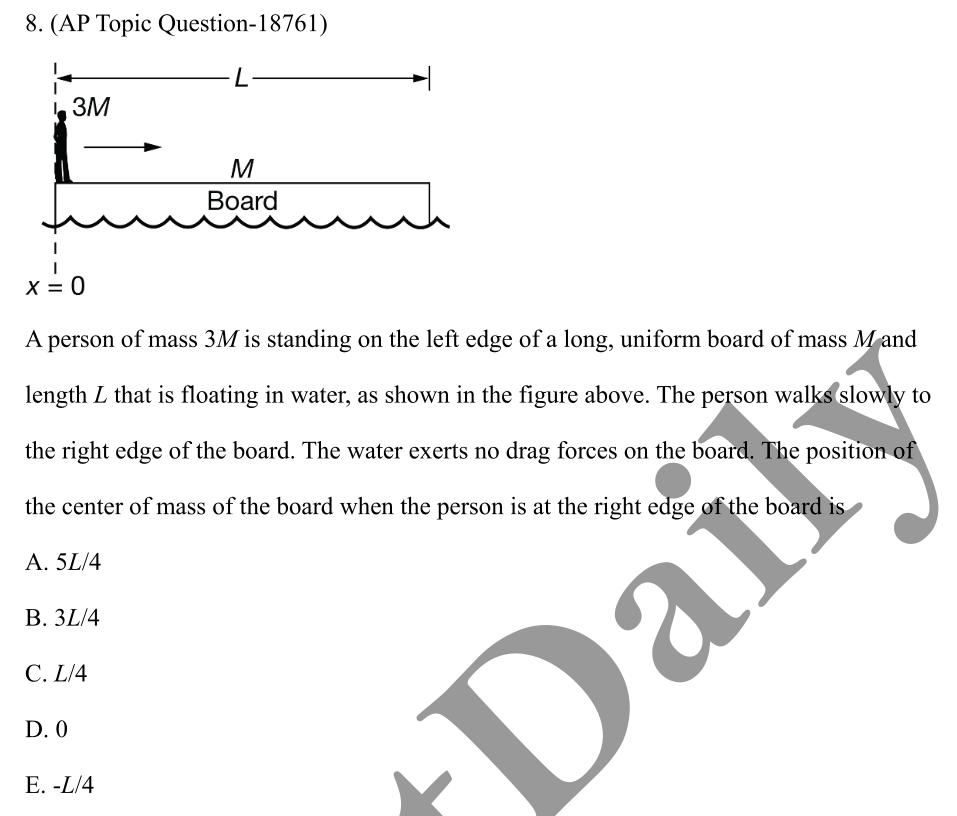
Notice that there is 0 net external horizontal force acting on the board. Therefore, the entire system of board and person is in equilibrium. According to
Quick Guide from AS to AP Mechanics#Position of Center of Mass
the coordinate of the center of mass of the system is fixed.
Before the person moves, .
After the person moves, the board will move to the left since the person will exert a leftward force to it. Denote the new coordinate of the center of mass of the board as . Because the board has a uniform mass, the coordinate of the center of mass of the person is .
Because is constant, . We can get . is the answer.
2
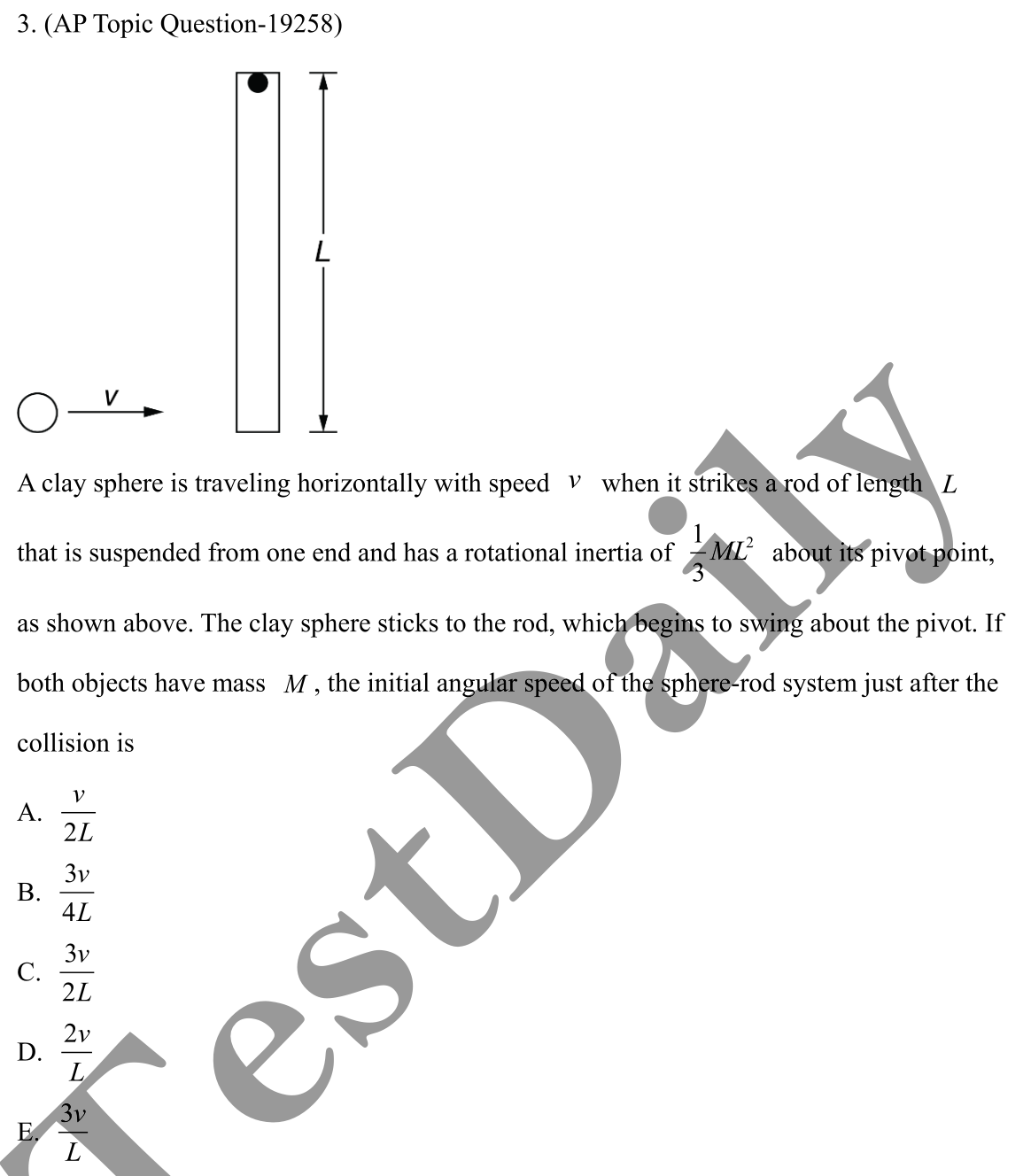
Because the pivot of the rod will exert a non-negligible external force, the linear momentum of the system is not preserved. However, the rotational momentum is preserved. Therefore, we only analyze the rotational momentum.
Before collision, . After collision, . Since the rotational momentum is preserved, . Therefore, .